LISTEN TO THE 'CUT TO THE CHASE: PODCAST'

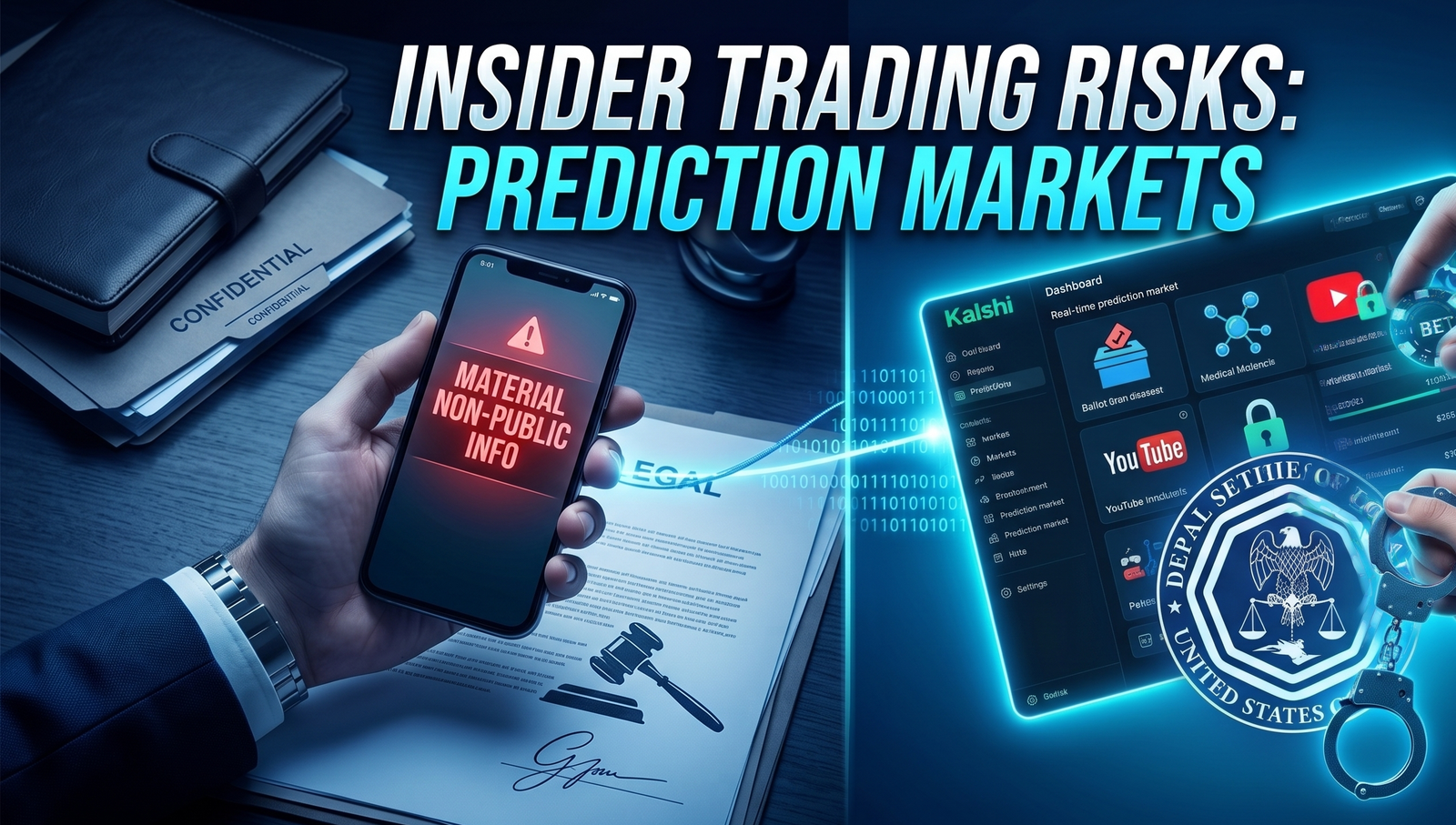
Last summer, a video editor named Artem Kaptur had a job, a phone and what he believed was a clean trade.
He worked for a YouTube channel. He knew what videos were coming before anyone else did. Release dates and content, the kind of advance knowledge that moves a prediction market contract before the public sees a single frame. So he opened Kalshi, placed his bets, and made money.
Then Kalshi’s compliance team found his trades. It investigated, confirmed the misappropriation and issued its judgment: disgorgement of $5,397.58 in profits, a $15,000 penalty and a two-year ban from the exchange. On Feb. 25, the U.S. Commodity Futures Trading Commission reviewed the matter and announced publicly[1] that the trader had potentially violated Section 6(c)(1) of the Commodity Exchange Act and Rule 180.1, the federal prohibition on insider trading in derivatives markets.[2]
He is one of many. He was just the first one caught on record.
On March 31, six days before the U.S. Court of Appeals for the Third Circuit handed Kalshi a preliminary injunction victory over New Jersey regulators in KalshiEx LLC v. Flaherty, CFTC Enforcement Director David Miller stood at New York University School of Law and said something worth repeating in full.
He called it a myth: the belief spreading across social media and mainstream coverage that insider trading law does not apply in prediction markets. “Insider trading violates the Commodity Exchange Act and our regulations’ anti-fraud provisions,” Miller said, adding that the Enforcement Division will “aggressively detect, investigate, and, where appropriate, prosecute insider trading in the prediction markets.”
That statement deserved larger headlines. It did not get them.
In the same remarks, Miller described his agency’s enforcement roster in plain language, the kind that reads differently once you understand what Kalshi’s platform actually is. In 2015, in In re: Arya Motazedi, a gasoline trader at a Chicago public company was accused by the CFTC of knowing every trade his employer planned and using that knowledge to place opposite-side orders against his own employer.[3]
In 2016, in In re: Jon P. Ruggles, an airline fuel-hedging manager was fined for running the same trades through
his wife’s accounts, pocketing $3.5 million.[4] In CFTC v. Clark, in which a consent order was filed on Jan. 29, a Texas energy trader was accused of turning his employer’s order book into a private tip sheet for an outside trader, conduct that drew a CFTC consent order and a criminal charge from the U.S. Department of Justice.[5]
Each case involved a regular job. Access to information that belonged to someone else. A belief that the trade was clean.
The YouTube editor fits the same profile. So does Kyle Langford, the political candidate who Gregg Goldfarb allegedly, in May 2025, traded event contracts on Kalshi on his own election campaign. He acknowledged the trades were improper when the platform contacted him, and Kalshi imposed a $2,246.36 penalty and a five-year ban.[6] His alleged conduct potentially violated the CEA’s prohibitions on manipulative schemes and fraud.
Two enforcement cases. Two documented violations. One advisory from the CFTC telling the country its Enforcement Division has full authority to pursue these cases federally, and intends to.
The Third Circuit’s April 6 ruling in KalshiEX LLC v. Flaherty did not create this enforcement environment. It ratified it.
The 2-1 decision, authored by U.S. Circuit Judge David J. Porter and joined by Chief U.S. Circuit Judge Michael A. Chagares, upheld a preliminary injunction barring New Jersey from enforcing its gambling laws against Kalshi’s sports event contracts. Judge Porter held that those contracts are swaps under the CEA and that the CFTC has exclusive jurisdiction over them.
“Kalshi’s sports-related event contracts are swaps traded on a CFTC-licensed DCM, so the CFTC has exclusive jurisdiction,” Porter wrote. “New Jersey frames the issue broadly,” he added, as “regulating all sports gambling” rather than narrowly, as “regulating trading on federally designated contract markets.” The statute, Porter found, favors the narrow framing.
This is a preliminary ruling on the likelihood of success. The merits are unsettled. The First Judicial District Court of the State of Nevada, Carson City, went the other direction on March 20 in State of Nevada ex rel. Nevada Gaming Control Board v. KalshiEx LLC, leaving Nevada’s enforcement action against Kalshi intact.
The U.S. Court of Appeals for the Ninth Circuit consolidated oral arguments in North American Derivatives Exchange v. Nevada (involving Crypto.com) and KalshiEX LLC v. Hendrick (a separate Kalshi Nevada appeal), which are scheduled for April 16. A circuit split may be headed to the U.S. Supreme Court. Prediction market traders are already pricing in Supreme Court review before year’s end.[7]
What the Third Circuit ruling confirms, regardless of how that fight resolves, is that Kalshi operates as a federally regulated derivatives exchange. The federal insider trading prohibition is real. The CFTC has jurisdiction. The app that looks like a sports betting interface is, under federal law, a designated contract market subject to the same anti-fraud authority the agency has used to prosecute traders in oil, gas and airline fuel hedging for a decade.
Miller was precise at NYU about who his agency is looking for. “Those who hold [material nonpublic information] are often subject to a web of legal and confidentiality obligations,” he said. “Chances are that trading on information you learn from work is going to breach duties of trust and confidence and subject you to insider trading liability.” Consider the job titles that description fits in the prediction market context.
A pharmaceutical employee who knows a clinical trial result before the announcement trades a contract on the company’s regulatory outcome. A sports trainer with advance knowledge of an injury — a hypothetical scenario Miller named specifically in his remarks — trades an event contract before the news breaks. A corporate communications staffer aware of an earnings miss three days before the press release. A campaign worker with internal polling data. A congressional aide whose boss sits on a committee with advance notice of a regulatory decision.
Congress has noticed. Multiple bills introduced in the 119th Congress take direct aim at this problem: the Prediction Markets Security and Integrity Act,[8] the End Prediction Market Corruption Act,[9] the Public Integrity in Financial Prediction Markets Act.[10] Each reflects the same recognition that the people using these platforms and the people writing the laws governing them are operating with different understandings of what the law already requires.
The CFTC’s position, stated plainly by Miller at NYU, is that the existing prohibition is adequate and active. The legislative push confirms how many people in positions of authority apparently had no idea.
I have spent 30 years representing people harmed because someone with more information used it without consequence. The prediction market insider trading problem is a specific and accelerating version of that pattern.
The people placing these trades mostly do not know they are committing federal violations. Kalshi presents itself as a consumer platform. The trades feel like bets. Nothing in the interface signals that the CEA applies, that Rule 180.1 exists, that the misappropriation theory of insider trading developed under the securities laws has been expressly extended to derivatives markets by the Dodd-Frank Act, and that the CFTC’s Enforcement Division recently named these markets its top enforcement priority.
But ignorance is not a defense. It never has been.
Kalshi has referred over a dozen cases to law enforcement in the past year. Federal prosecutors are actively examining whether those trades crossed the criminal line. The Third Circuit has confirmed the federal jurisdictional framework that makes prosecution viable.
The first federal criminal prosecution in this space has not happened yet.
The Ninth Circuit hears oral arguments on the same preemption question this week.
Whatever that panel signals, the enforcement accountability problem does not wait for appellate resolution. The trades are happening now.
The YouTube editor made his trades in August and September 2025. He found out what they cost him in February 2026. There are people making similar trades right now who have not found out yet.
The following article appeared on April 14, 2026 on Law360
—-
Gregg M. Goldfarb is the founder at Gregg M. Goldfarb LLP.
This article is for general information purposes and is not intended to be and
should not be taken as legal advice.
[1] CFTC Press Release No. 9185-26. https://www.cftc.gov/PressRoom/PressReleases/9185-26.
[2] CFTC Press Release No. 9185-26 (Feb. 25, 2026).
[3] In re Motazedi, CFTC Dkt. No. 16-02 (Dec. 2, 2015).
[4] In re: Ruggles, CFTC Dkt. No. 16-34 (Sept. 29, 2016).
[5] CFTC v. Clark, No. 4:22-cv-00365 (S.D. Tex., consent order Jan. 29, 2026).
[6] CFTC Press Release No. 9185-
26. https://www.cftc.gov/PressRoom/PressReleases/9185-26.
[7] https://polymarket.com/event/scotus-accepts-sports-event-contract-case-by-july-31-
2026.
[8] https://www.congress.gov/bill/119th-congress/senate-bill/4060.
[9] https://www.congress.gov/bill/119th-congress/senate-bill/4017.
[10] https://www.congress.gov/bill/119th-congress/house-bill/7004.